Every year, African governments face the same question: how do we finance schools, hospitals, infrastructure, climate adaptation, and jobs for a rapidly growing population?
The challenge is not simply a lack of ambition. It is a question of resources.
According to international estimates, developing countries face a widening financing gap for sustainable development that could reach USD 6.4 trillion by 2030. At the same time, many developing economies pay significantly higher borrowing costs than advanced countries, diverting resources that could otherwise be invested in development.
Discussions about development financing often focus on where new money will come from. Yet before asking that question, we should ask another: where is the existing money going?
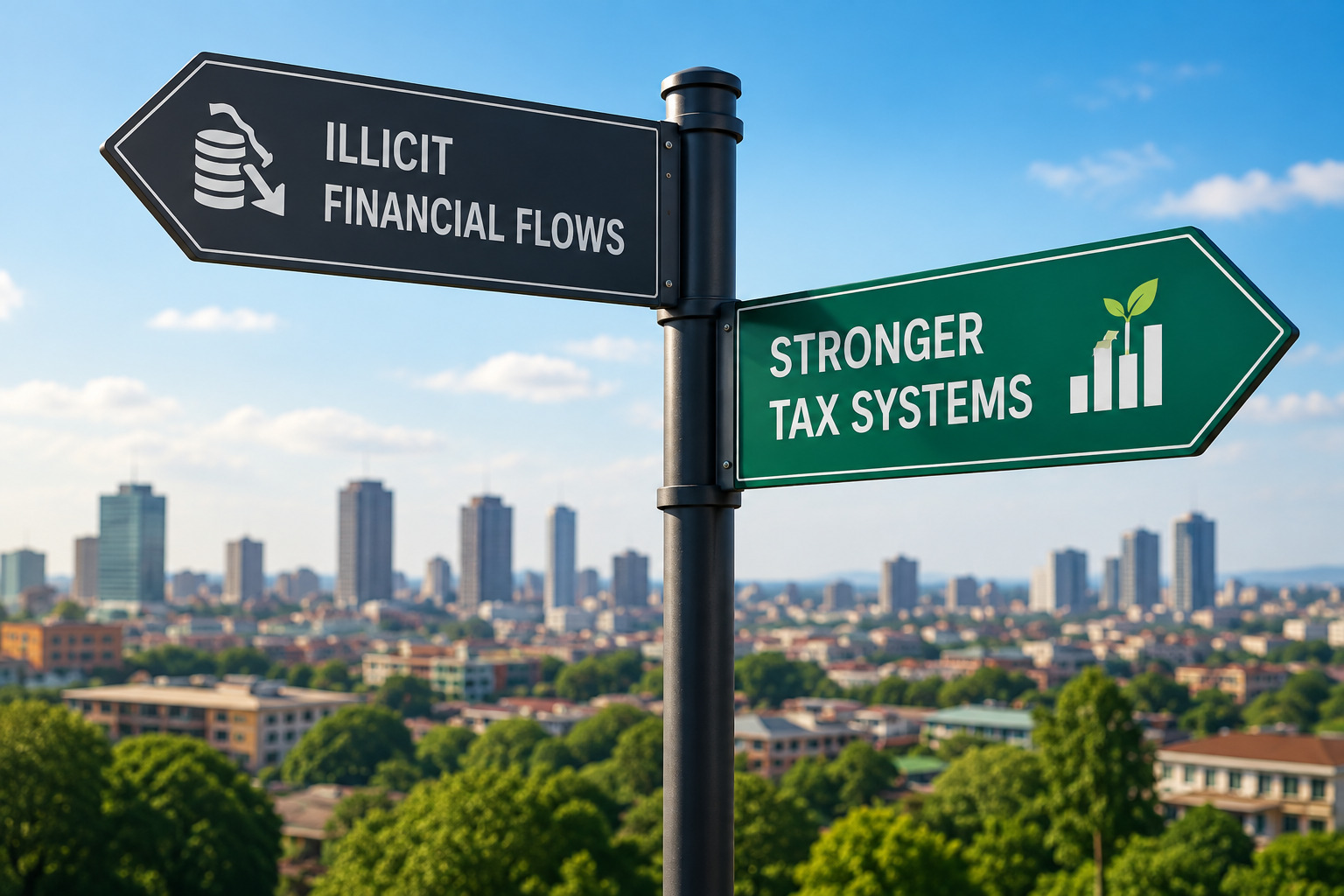
Part of the answer lies in illicit financial flows (IFFs).
IFFs are financial flows that are illicit in their origin, transfer, or use and that cross borders. In the tax context, they include practices such as tax evasion, customs and tariff offences, market manipulation, and certain forms of aggressive tax avoidance. These activities deprive governments of revenues that could otherwise support development priorities.
The impact is particularly significant in Africa because governments rely heavily on tax revenue to finance public services and national development programmes. Yet the continent’s average tax-to-GDP ratio has remained broadly stagnant at around 15% over the last decade, well below the levels needed to meet growing development demands.
According to UNCTAD’s Economic Development in Africa Report 2020, the continent loses an estimated US$88.6 billion every year through illicit capital flight—equivalent to 3.7 per cent of its GDP. This staggering outflow rivals the combined inflows of official development assistance and foreign direct investment, effectively eroding the resources Africa critically needs.
Every dollar lost to illicit financial flows is therefore a dollar unavailable for education, healthcare, infrastructure, and economic development.
The challenge is compounded by the structure of many African tax systems. Indirect taxes account for around 60% of total revenues, with VAT contributing more than 30% on average. Personal income tax contributes less than 20%, limiting the role of one of the most important progressive tax instruments. Revenue leakages in such an environment place even greater pressure on already constrained fiscal systems.
At the same time, illicit financial flows are becoming increasingly difficult to detect. Rapid technological change, digital business models, remote work arrangements, and complex cross-border transactions have created new opportunities for revenue leakage and tax avoidance. Many tax administrations are also operating with capacity constraints and institutional challenges that limit their ability to respond effectively.
Yet illicit financial flows are not inevitable.
Too often, discussions about domestic resource mobilisation focus on introducing new taxes. A more important question may be whether existing taxes are being effectively administered. Where compliance systems remain weak, additional taxes can increase the burden on compliant taxpayers while allowing non-compliance and illicit activities to persist. Strengthening compliance can therefore yield greater benefits than simply introducing new tax measures.
Addressing tax-related illicit financial flows requires more than stronger legislation. It requires access to information, effective compliance management, robust investigations, and cross-border cooperation. Tax administrations cannot tax income they cannot see, investigate assets whose ownership is hidden, or pursue tax claims that extend beyond their jurisdictions without international cooperation.
This reality has increased the importance of initiatives that strengthen transparency and information sharing. Across Africa, efforts supported through mechanisms such as the ATAF Agreement on Mutual Assistance in Tax Matters (AMATM), Exchange of Information programmes, beneficial ownership initiatives, and tools designed to strengthen the identification and monitoring of illicit financial flows are helping tax administrations build the systems needed to better detect, deter, and address revenue leakages.
These initiatives reflect an important shift in thinking. Tackling illicit financial flows is no longer viewed solely as a legal or enforcement issue. It is increasingly recognised as a central component of domestic resource mobilisation and sustainable development.
Ultimately, the conversation on Africa’s development financing often focuses on what the continent lacks. Yet an equally important question is what the continent loses.
Before asking where new resources will come from, governments must first ask where existing resources are going. Addressing illicit financial flows will not solve every development challenge facing Africa. But without doing so, closing the continent’s financing gap will remain significantly more difficult.
The resources needed to transform African economies may already exist. The challenge is ensuring they remain where they are needed most: supporting Africa’s development.